

As part of the Fulbright Visiting Scholar Program, the Fulbright-NATO Security Studies Award aims to foster awareness and understanding of NATO and to increase the level of debate on peace, security, and defense related issues. This award funds post-doctoral researchers, professors and professionals to conduct research and/or lecture at a U.S. institution for a period of three months in fields of study with a connection to NATO, including but not limited to cybersecurity, military history, nuclear disarmament and non-proliferation, peace and security, security studies, and transatlantic studies.
Applicants must include a letter of affiliation from a U.S. host institution in their application, and demonstrate in their Project Statement that their proposed research/course is relevant to NATO.
Objective
- Research and/or Lecturing
Application period
- September 15 till December 1 (at noon CET)
Important
- Review eligibility requirements below and include all required documents in your online application
Benefits
- Scholarship of 9,000 EUR for 3 months
- J-1 visa sponsorship
- Pre-departure support
- Travel stipend of 2,000 EUR
- Health benefit plan
- In-country programming (e.g. local advisor)
- Prestigious title and access to alumni network
Eligibility
- Citizenship in a NATO member country (excluding the U.S.)
- Proficiency in English
- Minimum of a PhD degree or other terminal degree
- Academic excellence, or outstanding personal or professional background
Required documents
- Americanized resume/CV
- 3-5 page single-spaced Project Statement (make sure to demonstrate relevancy to NATO!)
- 1-3 page Bibliography of References relevant to the proposed research
- Diploma of most recent degree including transcripts with completed coursework (certified translation in English unless the original documents are in Dutch, French or German)
- Three letters of recommendation (uploaded directly into online application by chosen recommenders)
- Letter of affiliation from a U.S. host institution; this letter should contain the institution’s letterhead, mention the exact dates, the objective of your research stay, as well as any facilities you may have access to during your grant
All these documents must be included in your application by December 1 including the affiliation letter.
How to apply
The application period to apply for this grant is between September 15 and December 1, 2026 for a research and/or lecturing stay of 3 months starting in the academic year of 2027-2028.
- Program proposals should be for a 3-month period and start no earlier than mid-August (the U.S. academic calendar typically runs from August/September to May/June)
- Every applicant needs to submit a complete online application in English via the Fulbright/IIE platform by December 1 at noon (CET)
- You must include all required documents in your application. Incomplete applications will not be considered for an award
- When creating an online account to start a new application, preferably use a personal email address instead of a temporary work or school address
When filling out the initial fields of the online application in the ‘Preliminary Questions’ section, applicants MUST select ‘NATO’ as the Program Country. This indicates that you are applying for a Fulbright-NATO award and ensures that your application is sent to our office and not to a different Fulbright Commission. In the ‘Country Information’ section you also need to specify that you are applying for the Fulbright-NATO Security Studies Award. We strongly encourage you to send us an email after submitting your application to verify that our office has received your application.
Keep in mind that the primary goal of this award is to foster awareness and understanding of the North Atlantic Treaty Organization (NATO) and to increase the level of debate on peace, security, and defense related issues at institutions of higher education in the United States and Europe. Research and/or lecturing proposals should have a strong connection to NATO, including but not limited to cybersecurity, military history, nuclear disarmament and non-proliferation, peace and security, security studies, and transatlantic studies.
The most competitive candidates demonstrate ambassadorial qualities and a genuine interest in cultural exchange. It is important for applicants to present a clear, creative, and feasible plan for their time in the United States, explaining why this is the right time to pursue their goals and how this grant will help them in achieving their personal and professional aspirations. The Commission seeks individuals who will also have a multiplier effect within their communities and wish to return to their home country to share their knowledge and experiences after their grant has ended.
Candidates are responsible for arranging affiliation on their own with an accredited U.S. university or non-profit research institution (e.g. research institutions or facilities, think tanks).
Note that nominated applications are subject to final approval by the Fulbright Foreign Scholarship Board (FFSB). Proposals may be reviewed for alignment with government priorities.

START APPLICATION (2027-28)
Please make sure to select ‘NATO’ as the Program Country when starting an application. Before starting a new application, please review the Application Guidelines on how to complete the online application.
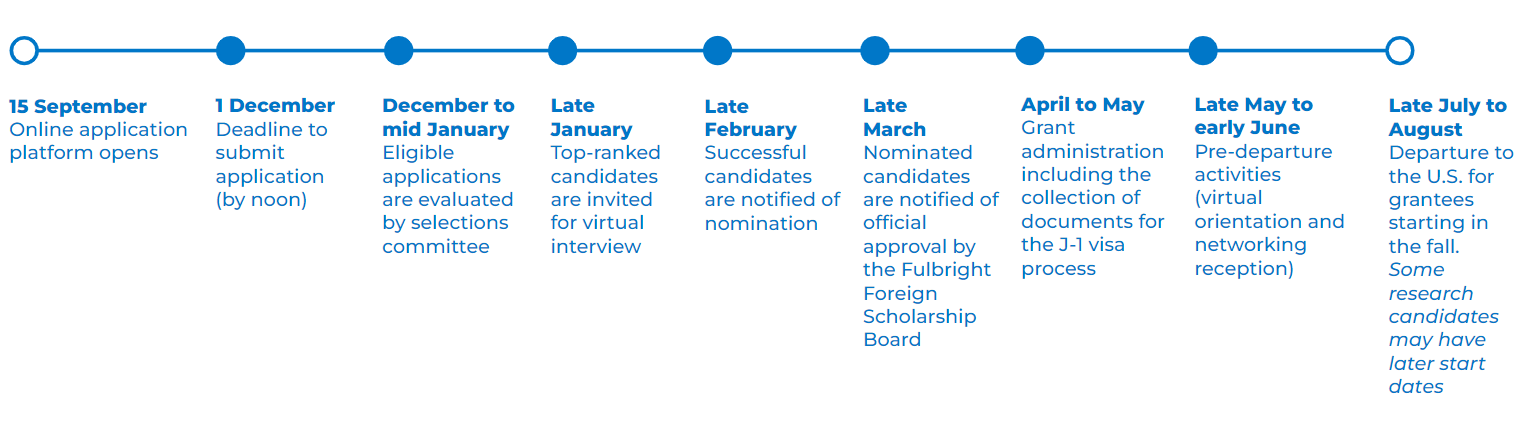
Timeline
FAQ
I am living abroad. Can I apply?
As a citizen of a NATO member country, you may apply for a Fulbright NATO award if you are living in any country except the United States. If you are a resident in the United States, a dual U.S. citizen, or hold a Green Card at the time of application, you are ineligible to apply.
I do not have citizenship in a NATO member country, but am currently living/studying/working there. Am I eligible to apply for the Fulbright NATO award?
No. Eligibility for the Fulbright Program is based on nationality, not residence.
I am currently pursuing my studies/research in the United States. Am I eligible to apply for the Fulbright NATO award?
Candidates who are already in the United States at the time of application and those who have resided in the U.S. for five or more years in the six-year period preceding the date of application are ineligible to apply. Furthermore, please note that preference may be given by the selections committee to candidates who do not have substantial recent experience in the U.S.
When is the deadline to submit an application?
Applicants need to submit an online application by December 1 at 12 PM (CET) and include the required documents. Incomplete applications will not be considered for an award.
Is the entire application in English?
Yes. The online application needs to be completed in English including the required documents. Exceptionally, you may include your diploma and transcripts in either Dutch, French or German. Any documents in other languages should be submitted along with a certified English translation.
Does the Fulbright Commission in Brussels require supplemental forms?
We do not require supplemental forms such as a letter from your home institution or official test results (e.g., TOEFL, GRE). The required documents that need to be included in your application can be viewed on the grant page.
How do I add the letters of recommendation to my application?
Letters of recommendation need to be submitted online by your chosen recommenders. In the online application, you will find a section called ‘Recommendations’ where you can register your recommenders. Once registered, they will receive an automatic email with the request to upload their letter of recommendation, which will be added to your application. After registering, you are able to track the status of these letters and send reminders. These letters need to be submitted in your application by the December 1 deadline.
Am I responsible for arranging my own affiliation to a U.S. host institution?
Yes. Applying to a host institution in the United States is a separate and independent process. In most cases, this will be an accredited U.S. university. Atypical host institutions may be non-profit research institutions (e.g. think tank, research institute, museum, etc.).
When do I need to provide proof of affiliation to a U.S. host institution in my application?
Scholar applicants are required to include an affiliation letter in their application by the December 1 deadline.
I submitted an application but never heard from the Fulbright Commission. What happened?
If you have not received any communication from the Fulbright Commission by late January, it is possible that we did not receive your application. This typically occurs when an applicant has not selected “NATO” as the Program Country in the application and, as a result, your application was sent to another Fulbright Program office.
As a participant in the Fulbright Program, will I be subject to the two-year home requirement after my grant?
Yes. All Fulbrighters are J-1 Exchange Visitors subject to a two-year home residency requirement also known as the foreign residence requirement under U.S. law, Immigration and Nationality Act, section 212(e). A two-year period of home residency is required before you may apply for a non-immigrant (e.g. H, L) visa as a temporary worker or for permanent residency in the United States. This requirement does not prevent you from reentry into the United States within the two-year period to attend conferences, tourism, or further study.
What is an Americanized resume?
While many examples of an ‘American’ style resume can be found online, there are some general guidelines that are different from a typical ‘European’ style resume. An American resume begins with your name and contact information (address, phone number, email address) at the top of the page. Most resumes will include sections about the applicant’s education, work experience and skills. Do not include personal information such as a photo, date/place of birth, nationality, or marital status.
Can I be affiliated with multiple host institutions during my stay in the U.S.?
Applicants are strongly encouraged to be affiliated with no more than one host institution while in the United States. This is to ensure that program participants have sufficient time to develop ties to their host institution and communities, an integral part of the cultural and academic exchange component of Fulbright.
What happens if I am offered a Fulbright award, but not an invitation from a U.S. host institution?
If you are not able to secure an affiliation to a U.S. host institution, the offer of a Fulbright award will be withdrawn.
Can I apply to more than one Fulbright Program?
No. Applicants should only apply for one Fulbright grant per year.
Does the Fulbright Commission cover the cost of tuition or other fees at my host institution?
No. The Fulbright Commission provides a scholarship and other in-kind benefits directly to the selected grantee. However, no additional funds are available for tuition/fees at the host institution.
Is the amount of the awarded grant calculated based on location in the U.S.?
No. The Fulbright Commission uses standardized monthly stipends regardless of the candidate’s intended host location in the U.S. Please take into account that living costs may vary in the U.S.