
Alberto Pavia was a Spanish 2025-26 Fulbright Schuman Visiting Student Researcher in Economics at the University of California, Berkeley. Alberto is a PhD candidate in Economics at KU Leuven, Belgium, specializing in macroeconomics. His data-driven research studies an important issue for economic resilience in large monetary unions like the Eurozone, specifically how economic shocks propagate across regions.
Q: “Can you briefly describe your grant project?”
My research examines how economic shocks affect different regions that share a currency, such as states in the United States or countries in the euro area. Because these regions cannot set their own monetary policy, they rely on other adjustment mechanisms, including financial markets, fiscal transfers, and the movement of workers and capital, to cushion economic downturns. During my Fulbright stay at UC Berkeley, I focused on how changes in government demand, particularly military procurement, affect investment, employment, and regional adjustment across U.S. states. By combining new data that I constructed together with empirical analysis and economic models, I used the United States as a laboratory for understanding how currency unions can become more integrated and resilient.
Q: “How did you initially learn about the Fulbright Schuman Program, and what motivated you to apply?”
Fulbright was one of those names I had heard long before I understood exactly what the program was. Many people I admired had been described as Fulbright scholars, so I associated it early on with intellectual excellence, international exchange, and public service. I wanted to work in a leading U.S. research environment, learn from scholars studying the American economy, and bring those insights back to Europe. The program therefore felt well matched not only to my project, but also to the kind of economist I wanted to become.
Q: “In what way is your specific field of research relevant to the transatlantic relationship?”
My research is inherently transatlantic because both the United States and the euro area are currency unions, but they have very different institutions for responding to regional economic shocks. America is a very big place. Several U.S. states are comparable to European countries in population and economic size. Belgium, for example, has approximately the same population as Ohio and an economy of roughly the same scale as Michigan’s. However, the euro area is a much younger currency union, and its member countries remain less integrated than U.S. states. U.S. states share a federal fiscal system and highly integrated capital and labor markets, while euro-area countries retain much more national responsibility for economic stabilization. Comparing the two systems helps us understand how mechanisms such as fiscal transfers, financial integration, and the mobility of workers and capital can reduce regional disparities and make Europe more resilient. At the same time, studying differences across U.S. states contributes to American debates about why national policies and economic shocks affect different parts of the country so unevenly.
Q: “What have you accomplished during your time in the USA? What can you tell us about the initial outcomes of your program?”
During my Fulbright grant, I constructed a new state-level dataset on investment and other regional economic outcomes and used it to study how U.S. states respond to changes in military spending. I presented the project at UC Berkeley and at the Federal Reserve Bank of San Francisco. I had regular discussions with faculty members and fellow PhD students that helped me substantially refine both my empirical analysis and the economic mechanisms behind the results.
Q: “Can you describe a typical day in your life in the USA?”
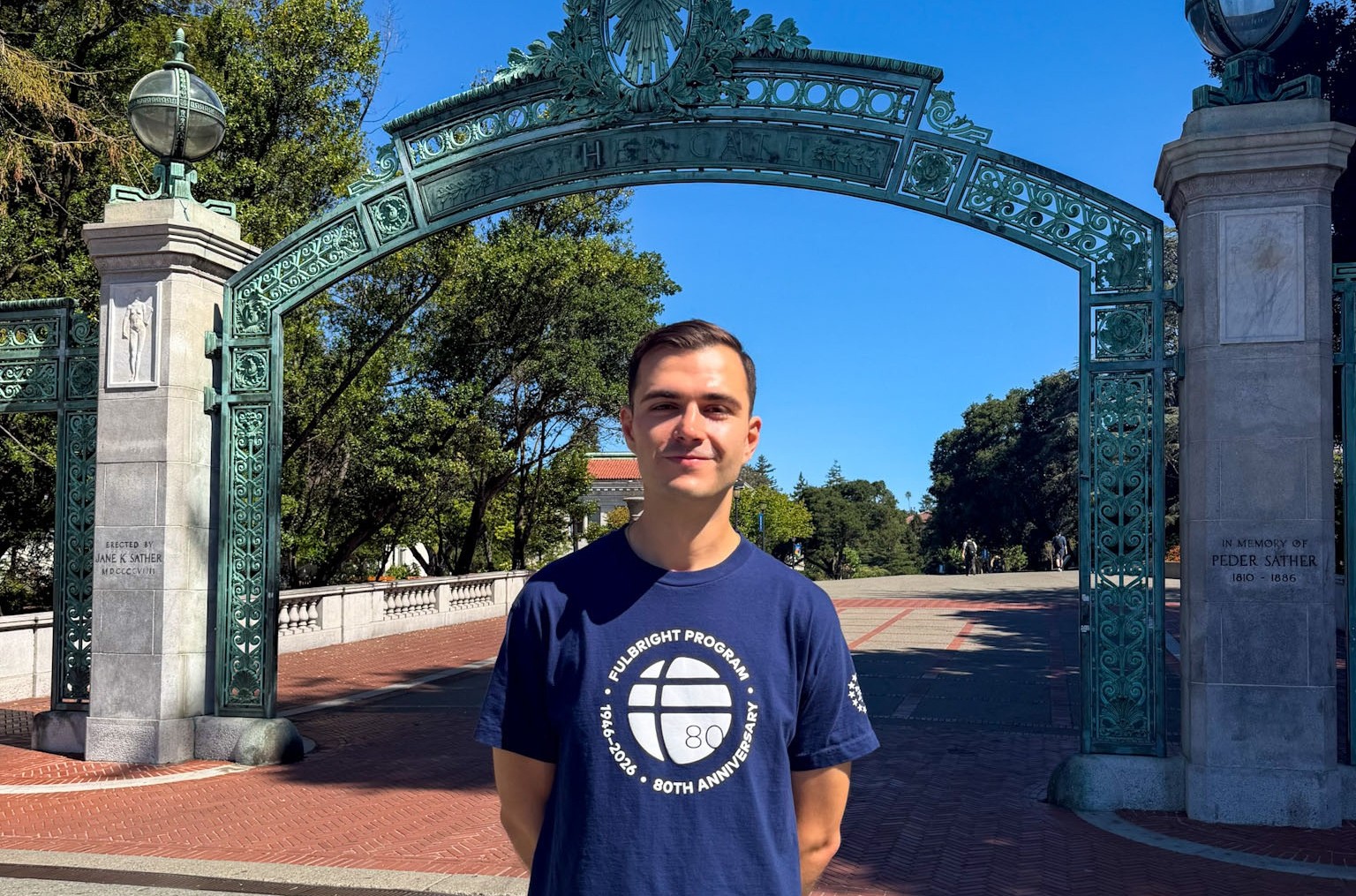
A typical weekday was surprisingly ordinary, in the best possible way. I would go to the office in the morning, work on my research, attend seminars, and talk with colleagues. Thanks to being in sunny California, I would usually have lunch outside in the sun, even in January, followed by my daily coffee break at one of the campus coffee shops. A lot of my social interactions happened quite spontaneously around these times, through lunches, coffee breaks, dinners, drinks or conversations after seminars with American and international colleagues. I would return home around 6 or 7 p.m., cook dinner, and either visit my building’s gym or go for an evening walk. In the evening, I would also call friends and family in Europe. The time difference also meant that meetings with European colleagues occasionally took place close to midnight, so I became accustomed to shifting across time zones. On weekends, I tried to explore as much of the Bay Area as possible, hiking in the Berkeley Hills and the Golden Gate National Recreation Area, walking along the coast, and discovering different parts of San Francisco.
Q: “Has the United States been what you expected? In what ways has life in the USA surprised you, either for its similarities to or differences from your own culture.”
Yes and no. I expected the United States to feel large, diverse, and energetic, and it certainly did. What surprised me was how quickly everyday life became “familiar”. My colleagues were welcoming, people were remarkably easy to talk to, and Berkeley felt like a place where intense academic work and a very informal social culture coexist naturally. Also, I ended up spending a lot of time with other international colleagues, due to UC Berkeley’s international atmosphere. At the same time, the country felt much less uniform than the version of “America” that we often discuss in Europe. California is vast and has its own geography, habits, and rhythm of life. Even the Bay Area contains striking contrasts within a relatively small space. I left with a much stronger sense that the United States is a mosaic of overlapping regional cultures.
Q: “What has been your favorite “discovery” in the USA?”
I have to admit that I became a convert to the American custom of always carrying a large beverage. When I first arrived, I found it slightly amusing that everyone seemed to be walking around with enormous water bottles, half-liter coffees, and one-liter soft drinks. I quickly realized just how convenient it was. After a lifetime of drinking almost exclusively espresso-based coffee, I also became fond of filter coffee. Now that I am back in Europe, I am experiencing a small reverse culture shock as I readjust to tiny drinks, cold beverages without enough ice, and the absence of free refills. One of my policy proposals for Europe is to seriously reconsider the last one!
Q: “What will you do after your Fulbright grant? In what ways has your experience in the USA this year impacted your plans for the future?”
My immediate priority is to return to Belgium and finish my PhD. My Fulbright experience left me with the fortunate problem of having more promising research questions and collaborations than when I arrived. It made my research agenda both more ambitious and more international. I plan to continue working with colleagues in the United States and to return for research visits as these projects develop. More broadly, the experience confirmed that I want to build a career around international collaboration.
Q: “As a Fulbright Schuman grantee, you have been a cultural ambassador not just for your home country but for the entirety of the European Union. Has this experience changed what it means to be “European” for you?”
I have always cared deeply about cross-cultural exchange and the transatlantic relationship. I am a Spanish citizen who has lived in several European countries, and each move has given me a slightly different understanding of what it means to be European. Strangely, however, living in the United States is perhaps the experience that has made my European identity the most visible to me. In Europe, I have lived in countries where I did not initially speak the local language. Despite that language barrier, I always felt like I was inside a common cultural and institutional world. In the United States, I faced no language barrier, but I became much more conscious of the habits, assumptions, and experiences that Europeans often share across national borders and which transcend language. At the same time, the physical distance also made the closeness of the transatlantic relationship clearer to me. After a 13-hour flight from Madrid to San Francisco, I still landed somewhere with familiar academic traditions, cultural references, and ways of understanding the world. The experience made me feel more distinctly European, but also more convinced that Europe and the United States belong to a broader community with a great deal worth preserving.
Articles are written by Fulbright grantees and do not reflect the opinions of the Fulbright Commission, the grantees’ host institutions, or the U.S. Department of State.